
Bismarck's policy of alliances in the Empire
With his foreign policy, the German Chancellor Otto von Bismarck pursued the goal of isolating the "hereditary enemy" France and preventing possible revenge campaigns.Alliances with Russia, Austria-Hungary and Italy were also intended to position the new German Empire securely in the middle of the major European powers and, in particular, to help avoid a two-front situation in the event of war. In 1873, the Three Emperors' Agreement was concluded with Russia and Austria-Hungary, but this failed in 1885/86 due to differing interests in the Balkans. The Dual Alliance with Austria-Hungary followed in 1879, followed by Italy in the Triple Alliance of 1882. Of particular importance was the secret reinsurance treaty with Tsarist Russia (1887), which was initially concluded for three years and in which neutrality was mutually assured in the event of war by a third party. After Bismarck's dismissal in 1890, Kaiser Wilhelm II decided not to extend the treaty and to protect the German Empire through its own military build-up rather than through alliances.

30.06.1889 - Bismarck, Dreibund im Hippod./ Karikatur Bismarck, Otto von; Staatsmann; 1815-1898. - "Der Dreibund im Hippodrom". - (Karikatur auf den Dreibund Deutsches Reich, Oesterreich-Ungar...
3145459

20.05.1882 - Dreibund 1882 / Vertragstext mit Unters. Dreibund (Verteidigungsbuendnis zwischen Deutschem Reich, Oesterreich-Ungarn und Italien), unterzeichnet in Wien am 20. Mai 1882. - Vertra...
3163014
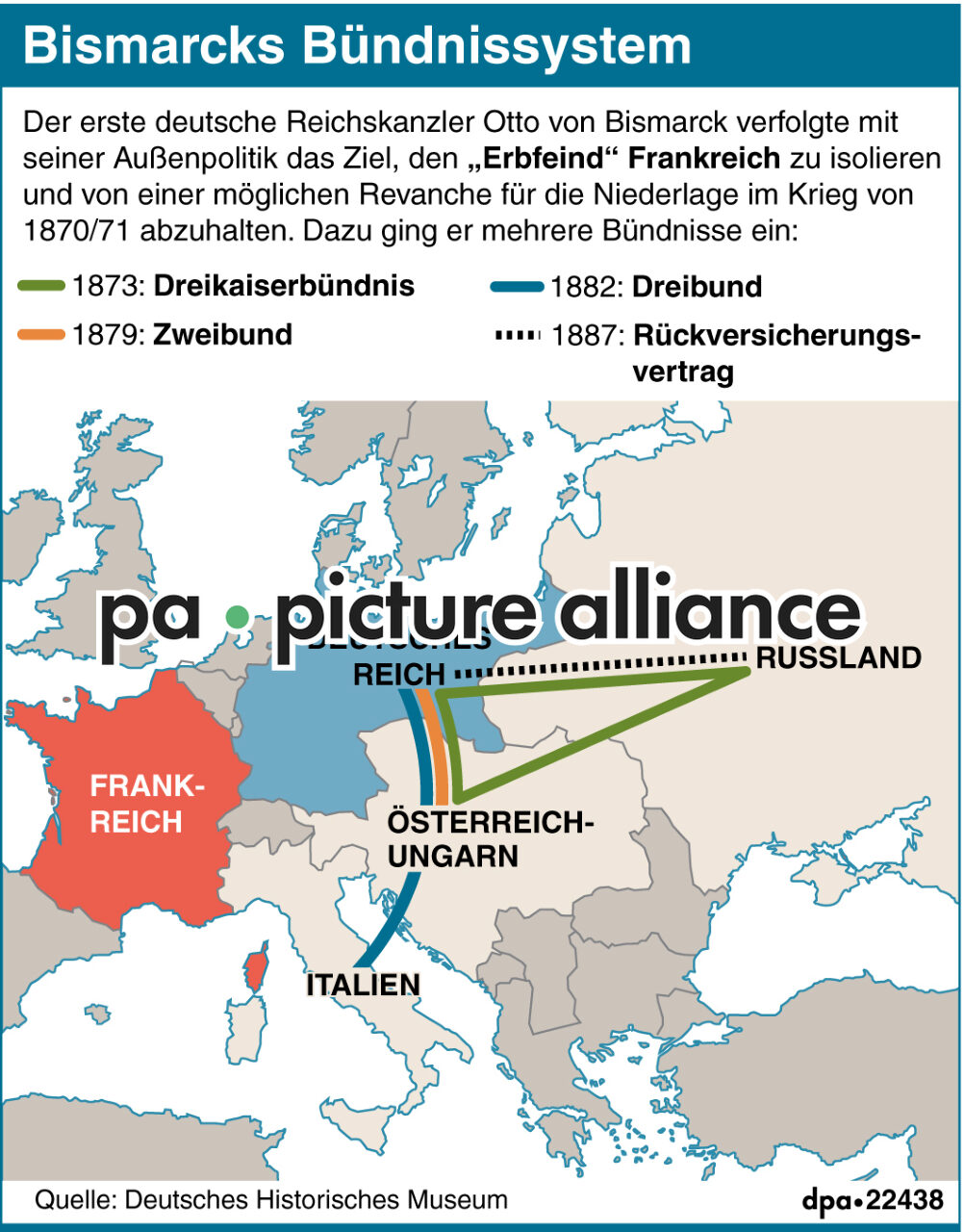
31.03.2015 - Die Bündnisse des Deutschen Reichs unter Reichskanzler Otto von Bismarck, 1873 bis 1887, Hochformat 90 x 115 mm, Grafik: A. Brühl, Redaktion: A. Brühl/K. Klink
56830974

01.01.1887 - Bismarck, Otto von; Staatsmann.
18151898.
Das Meerungeheuer.
(Karikatur).
Französisches Flugblatt, 1887.
Spätere Kolorierung.
84044218

01.01.2000 - Bismarck, Herr von Giers / Karikatur Bismarck, Otto von; Staatsmann; 1815-98. - "Herr von Giers. Ich sei, gewaehrt mir die Bitte, In eurem Bunde der Dritte". - (Karikatur auf die...
3144856

01.01.2000 - Bismarck, Kaltes Blut... / Karikatur Bismarck, Otto von; Staatsmann; 1815-98. - "Kaltes Blut und warm angezogen. / Im- mer zu, Kinder, kachelt nur feste ein, ihr bringt den Ofen d...
3144922

01.01.1878 - 8-1878-6-13-A1 (71461)
Berliner Kongreß/ Die Teilnehmer/ 1878
Berlin, 13. Juni bis 13. Juli 1878
Berliner Kongreß (Eine Zusammenkunft der
europ. Großmächte und der Türkei unter
V...
30304903

25.01.1913 - Dreibund 1912 / Karik.Wahrer Jacob 4. Erneuerung des Dreibunds zwischen Deutschem Reich, Oesterreich-Ungarn und Italien am 5. Dezember 1912. - "Die oestreichische Suppe am deutsch...
3142087
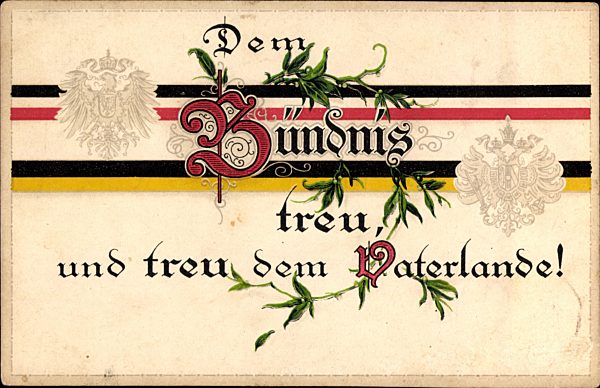
30.11.1934 - Dem Bündnis treu, und treu dem Vaterlande, Kaiserreich, Österreich
83367727

11.02.1902 - Bernhard v. Buelow, Karikatur 1902 Buelow, Bernhard, Fuerst von; Politiker (Reichskanzler 1900-09); 1849-1929. - "Eine Extratour. / Seiltaenzer: Na, im schlimmsten Falle verlass'...
3141849

01.01.1876 - Franz Joseph I., Kaiser von Österreich u. König von Ungarn, 18301916.
Zusammenkunft Kaiser Franz Josephs mit Zar Alexander II. von Rußland in Reichstadt 1876.
Holzstich, zeitg...
84020242

30.12.1883 - 9-1882-5-20-C3 (73711)
Dreibund-Karikatur aus Lustige Blätter
Dreibund (Verteidigungsbündnis zwischen
Deutschem Reich, Österreich-Ungarn und
Italien), unterzeichnet am 20. Mai 18...
30302855

16.10.1879 - Zweibund,Kaiser Wilhelm I.,Franz J. Geheimes Verteidigungsbuendnis zwischen Deutschem Reich und Oesterreich-Ungarn (Zweibund), unterzeichnet am 16./17. Oktober 1879. - Kaiser Wilh...
3202219

16.10.1879 - Zweibund 1879 / Vertragstext mit Unters. Geheimes Verteidigungsbuendnis zwischen Deutschem Reich und Oesterreich-Ungarn (Zweibund), unterzeichnet am 16./17. Oktober 1879. - Vertra...
3163017

01.01.1860 - Count Guyla Andrassy created the League of the Three Emperors with Otto von Bismarck. Photography. Hungary. Around 1860
7951654

01.01.1872 - Dreikaisertreffen in Berlin, 5. bis 11. September 1872.
- Der Zapfenstreich am Abend des 7. September Unter den Linden. -
Holzstich, 1872, nach Zeichnung von Friedrich Kaiser (181...
114448671

01.01.1873 - 8-1872-9-5-A1 (204089)
'Die Drei-Kaiser- Zusammenkunft in Berlin'
Dreikaisertreffen in Berlin 5. bis 11.
September 1872. / - 'Die Drei-Kaiser-
Zusammenkunft in Berlin' (Wilhelm I...
30360015

15.07.1884 - Bismarck, 3 Kanzler 1884 / Lueders Bismarck, Otto von; Reichskanzler; 1815-1898. - "Vor der Dreikaiserbegegnung in Skier- niewice: Die drei Kanzler". (Russ.Polen, 15.-17.Sept.1884...
3139753

01.01.2000 - Dreikaisertreffen Berlin 1872 / Ehrentr. Dreikaisertreffen in Berlin, 5. bis 11. September 1872. - "Besuch der Monarchen im neuen Anti- lopenhaus des Zoologischen Gartens am 8. Se...
3292290

28.09.1872 - 8-1872-9-5-A1-1 (1108138)
'Die Drei-Kaiser-Zusammenkunft: Empfang des Kaisers von Rußl
Dreikaisertreffen in Berlin 5. bis 11. September 1872.
- 'Die Drei-Kaiser-Zusammenkunft: Em...
30531997

01.01.2000 - Dreikaisertreffen 1872 / Parade Dreikaisertreffen in Berlin 5. bis 11. September 1872. - "Die grosse Parade auf dem Tempelhofer Feld am 7. September". - (v.li. Kaiser Wilhelm I.,...
3292293
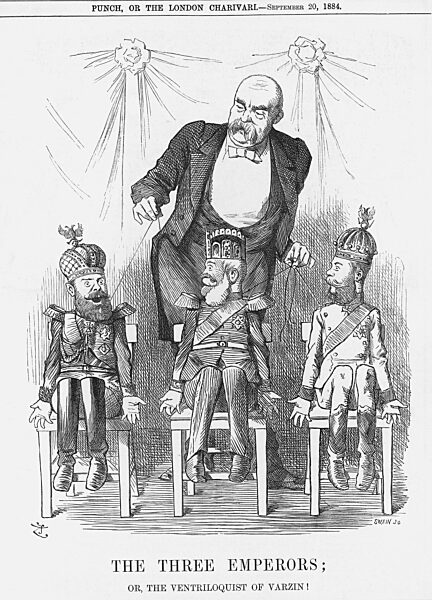
01.01.1000 - 'The Three Emperors', 1884. Prince Bismarck is the puppet-master in this cartoon. The puppets are the Emperors of Austria, Germany and Russia who had met at Skiernievice in Russia...
401049859

01.01.2000 - Franz Joseph und Wilhelm II. Berlin 1900 Franz Joseph I., Kaiser von Oesterreich, 1830-1916. - Kaiser Franz Joseph in Berlin: Mit Kaiser Wilhelm II. im Wagen auf dem Pariser Platz...
4282450

01.01.2000 - Otto von Bismarck / Foto 1890 Bismarck, Otto von Staatsmann (Reichskanzler) Schoenhausen 1.4.1815 - Friedrichsruh 30.7.1898. Portraetaufnahme, Bad Kissingen 1890 (Pilartz).
4265292
Haven't found what you're looking for? Register or login to get access to a larger selection of images and use our full range of images, videos and graphics.
Kontakt
Haben Sie Fragen? Kontaktieren Sie uns.