
Weimar Republic - Inflation 1923
After World War I, the German Empire was also financially at the end of its rope. War costs, high reparation claims, territorial and economic losses and finally the Ruhr struggle in January 1923 led to an ever faster decline of the currency. Hyperinflation reached its peak in the fall of 1923, when the Reichsbank printed a bill for 100 trillion marks as the highest value. The savings of many citizens were wiped out, war bonds were worthless, and people paid with valuables or food. With the introduction of the Rentenmark on November 15, 1923, a new monetary order came into effect and ended inflation. The Rentenmark was replaced by the Reichsmark in August 1924.

01.01.2000 - Banknoten der Inflation 1923 Finanzwesen / Banknoten / Deutsches Reich (Banknoten der Inflation 1919-24). - Banknoten und Scheine der Jahre 1922 /1923. - Berlin, Slg.Archiv f.Kuns...
3430628

01.01.1923 - Preisvergleich, der das Ausmass der Geldentwertung verdeutlicht: '1 Zentner Briketts kostet jetzt 15000 Mark, demnach wäre der Preis für 1 Brikett 150 Mark; dafür gab es früher ein...
95613895
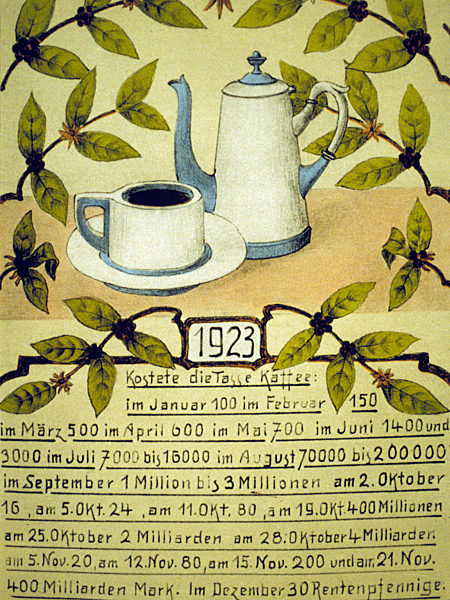
01.01.1923 - A postcard from Bremen showing a coffee cup and coffeepot from 1923 during the inflation period.
17487781

01.01.2000 - Fuenfzig Milliarden Mark 1923 Finanzwesen / Geld: Deutsches Reich. - "Fuenfzig Milliarden Mark". - Reichsbanknote, 26.Oktober 1923.
3478799

30.11.1999 - Geldscheine, die während der Inflation 1923 nur noch Makulatur sind, werden gewogen.
2299180

30.11.1922 - Männer, Frauen und Kinder suchen auf einer Schutthalde nach Heizmaterial, aufgenommen während der Inflation 1923 zur Zeit der Weimarer Republik.
1287518

30.11.2002 - Während der Inflationszeit in den 20er Jahren steht eine lange Schlange von Männern, die Geldscheine für die Lohnauszahlung benötigen, vor der Berliner Reichsbank.
6748407

01.01.2000 - Fuenf Billionen Mark 1923 Finanzwesen / Geld: Deutsches Reich. - "Fuenf Billionen Mark". - Gutschein Deutsche Reichsbahn, Karls- ruhe den 15. November 1923. (Vorderseite).
3478805

15.10.1923 - Inflationsbriefmarke 1923 Weimarer Republik / Inflation 1923. - Briefmarke der Deutschen Reichspost ueber Dreissigtausend Mark. -
3295110

30.11.1922 - Ein verhafteter Deutscher wird vor dem Frankfurter Hauptbahnhof von zwei französischen Soldaten abgeführt. Die Deutschen konnten Anfang 1923 die ihnen durch den Versailler Vertrag...
2145331

01.01.2000 - Inflation 1922/23 /Inflationsgeld... Inflation 1922/23. Inflationsgeld aus den Jahr 1923. - Reichsbanknote 1.000.000 Mark und eine Reichsbanknote 1.000 Mark, ueber- stempelt mit d...
3126687

19.09.1923 - Inflation: Naturalien an der Theaterkass
Weimarer Republik / Inflation 1923:
- Bezahlung mit Naturalien an der
Theaterkasse des Schlossparktheaters
in Berlin-Steglitz. -
Foto, 19....
3188662

01.01.2000 - Inflation/Crowds in front of Reich Bank Weimar Republic / Inflation 1923. - Crowds in front of the main Reich Bank in Berlin. - Photo, 1923.
3144469

30.11.1922 - Mitarbeiter eines großen Betriebs holen während der Inflation 1923 das für die Lohnauszahlung benötigte Geld gleich waschkörbeweise von der Bank.
2145406

01.09.1923 - Fuenfzig Millionen Mark 1923 Finanzwesen / Geld: Deutsches Reich. - "Fuenfzig Millionen Mark". - Reichsbanknote, 1.September 1923.
3478808

01.01.2000 - Inflation: Verkauf von Kartoffeln 1923 Weimarer Republik / Inflation 1923: - Berliner Bevoelkerung umlagert einen Kartoffelhaendler, der seine Ware vom Wagen unter Polizeischutz v...
3078873

01.01.2000 - Inflation / Waiters demonstrate... Weimar Republic / Inflation 1923. - Berlin waiters demonstrate against "Tips compensation" in front of the Reich Chancellery building. - Photo,...
3126603

01.01.2000 - Inflation 1922/23: Transporting money. Weimar Republic / Inflation 1922/23. - Trolleys filled with bank notes in the safe area of a bank. - Photo, 1923.
3144472

01.01.1923 - Inflation 1922/23, Werfen von Banknoten
Deutschland / Weimarer Republik /
Inflation 1922/23.
- Wertlos gewordene 100 Mark-Scheine
werden aus einem Automobil in die
Menge geworfen....
11979074

30.11.1922 - Menschen vor einer städtischen Verkaufsstelle für Freibankfleisch, in der minderwertiges und nur bedingt taugliches Fleisch verkauft wird, aufgenommen während der Inflation im Jah...
2110568

30.11.1922 - Ein armer alter Bettler bittet während der Inflation 1923 um eine milde Gabe.
2143766

01.01.2000 - Banknoten der Inflation 1923 Finanzwesen / Banknoten / Deutsches Reich (Banknoten der Inflation 1919-24). - Banknoten des Zeitraums Juli - Novem- ber 1923. - Berlin, Slg.Archiv f....
3430622

30.11.1999 - Während der Inflationszeit in den 20er Jahren steht eine lange Schlange von Männern, die Geldscheine für die Lohnauszahlung benötigen, vor der Berliner Reichsbank.
2516192

01.01.1922 - Inflation 1 Ei 120 Mark
Inflation 1922/23.
- 1 Ei 120 Mark. -
Foto, spaetere Kolorierung.
E:
Inflation, One Egg 120 Marks / Photo
Inflation 1922/23.
- One egg 120 Marks. -
Phot...
9125601

19.09.1923 - Inflation: Naturalien an der Theaterkass Weimarer Republik / Inflation 1923: - Bezahlung mit Naturalien an der Theaterkasse des Schlossparktheaters in Berlin-Steglitz. - Foto, 19....
3078870

15.10.1923 - Inflationsbriefmarke 1923 Weimarer Republik / Inflation 1923. - Briefmarke der Deutschen Reichspost ueber 10 Millionen Mark. -
3204291

01.01.2000 - Zweihundert Milliarden Mark 1923 Finanzwesen / Geld: Deutsches Reich. - "Zweihundert Milliarden Mark". - Reichsbanknote, 15.Oktober 1923.
3478802

01.01.2000 - Inflationsbriefmarke 1923 Weimarer Republik / Inflation 1923. - Briefmarke der Deutschen Reichspost ueber 20 Milliarden Mark. - (Letzte Briefmarkenausgaben der Deut- schen Reichsp...
3294836

30.11.1999 - Während der Inflationszeit in den 20er Jahren herrscht großer Andrang vor der Verkaufsstelle für minderwertiges Fleisch in Berlin.
2516195

01.11.1923 - Germany, Weimar Republic Inflation Bank note of one trillion Mark = 1000 billions Mark - November 1923
95650755

01.01.2000 - Inflation 1922-23 /Money Baskets/ Photo Weimar Republic / Inflation 1922-23. - Money being carried in baskets, in front of a bank in Berlin. - Photo.
947546

01.01.1923 - Arnut, Elendsunterkunft,Deutschland 20er
Gesellschaft:
Soziales / Armut.
- Frauen mit Kindern in einer
Elendsunterkunft in Deutschland,
Weimarer Republik (Infaltionszeit 1922/
192...
11978797

30.11.1922 - Eine Frau bezahlt während der Inflation 1923 ihren Einkauf mit einem Stapel Geldscheine.
1287608

15.10.1923 - Inflationsbriefmarken 1923 Weimarer Republik / Inflation 1923. - Zwei Briefmarken der Deutschen Reichspost ueber 2 Millionen und 50 Millionen Mark. -
3204288

30.11.1999 - Ein Händler verkauft während der Inflationszeit in den 20er Jahren Schuhe, die er unter dem Mantel versteckt hält, auf der Straße.
2299177

01.01.1923 - Geldtransport in Koerben 1922/23
Weimarer Republik / Inflation 1922/23.
- Geldtransport in Koerben vor einer
Bank in Berlin. -
Foto, spaetere Kolorierung.
3188677

01.01.2000 - Banknoten der Inflation 1923 Finanzwesen / Banknoten / Deutsches Reich (Banknoten der Inflation 1919-24). - Banknoten und Scheine der Jahre 1922 /1923. - Berlin, Slg.Archiv f.Kuns...
3430619
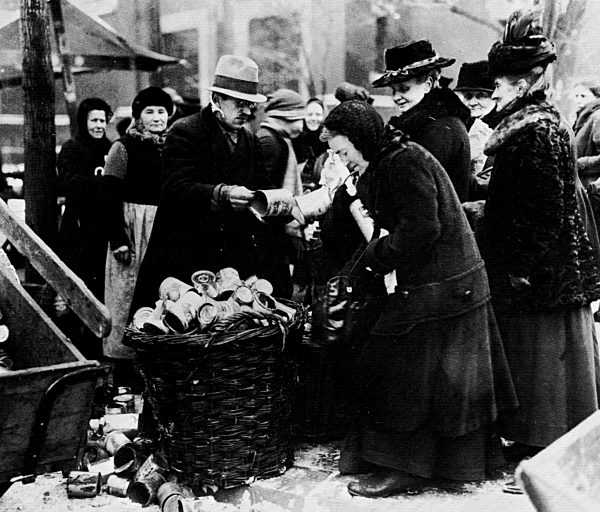
07.05.2002 - Poverty in Germany between the wars 1923/1924. Tin cans are sold by middle class women who neededevery pfenig to keep their families going. Germany / Mono Book Illustration
10049877

01.08.1924 - Schlange vor Berliner Leihamt 1924
Weimarer Republik / Wirtschaftskrise.
- Schlange vor einem Berliner Staedti-
schen Leihamt, Jaegerstrasse 64, im Sommer
1924 als Folge der Infla...
14583307
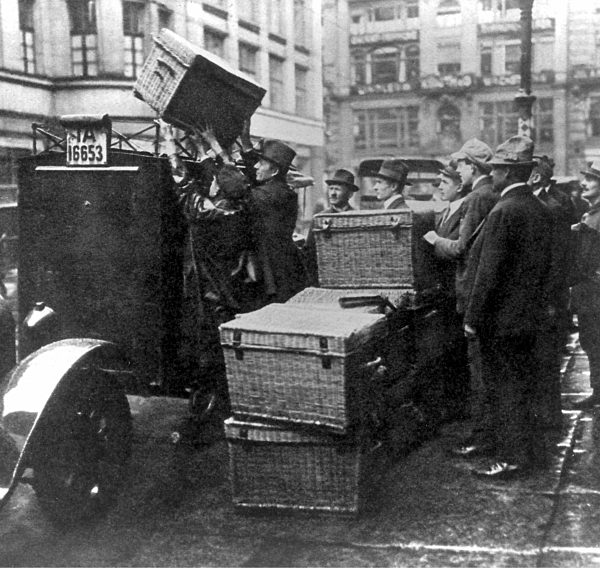
25.12.1999 - Inflationary money Germany wage money in laundry baskets. 1923 Germany / Mono Print
9828243
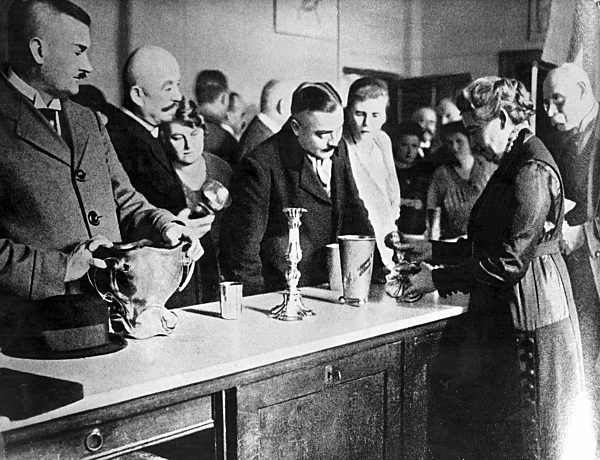
25.12.1999 - German inflation BTW. Selling heirlooms to the pawnshop Germany / Mono Print
9827967

01.01.1923 - 8-1923-0-0-H1-8 (138269)
Inflation/Warteschlange v.Reichsbank1923
Weimarer Republik / Inflation 1923.
- Warteschlange vor der Reichshauptbank
in Berlin.-
Foto, 1923.
E:
Inflatio...
30342695

01.01.1920 - Erwerbslosenfuersorge Berlin 20er Jahre
Weimarer Republik / Arbeitslosigkeit:
- Auszahlung der Unterstuetzung in einer
Zahlstelle der Erwerbslosenfuersorge. -
Foto, Berlin, 20er J...
9125567

01.01.2000 - Economic Crisis. Germany: Weimar Republic / Economic crisis. - Unemployment and famine in Thuringia 1924: The local council of Deesbach issues "begging entitlements" to the popula...
3204354

01.01.1929 - Bankruptcy of German Civil Servant Bank due to bad speculations. Claimants in front of the bank. Photography. 1929.
7950413

01.01.2000 - Inflation 1 Egg 120 Mark. Germany: Weimar Republic / Inflation. Inflation 1922/23. - 1 Egg 120 Marks. - Photo.
3204256
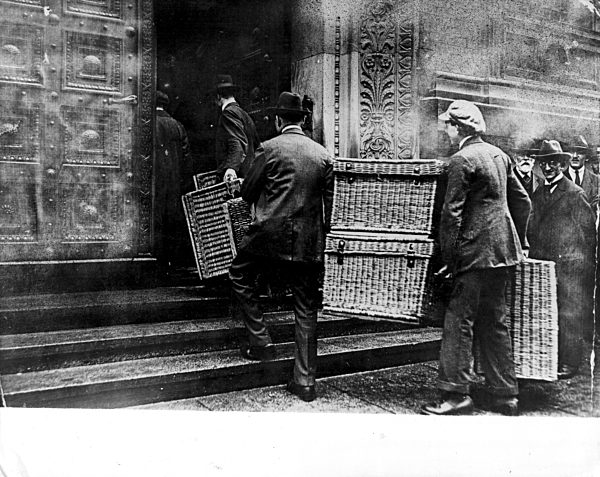
17.07.1998 - Owing to the enormous fall of the mark there has been a great demand for additional money with which to pay wages. Clerks entering a Berlin Bank with large baskets to collect the r...
9830065

01.01.2000 - Deutschland, Germany, Weimarer Republik, Berlin 1920 : Städtisches Asyl für Obdachlose in der Fröbelstrasse, Warteschlange, Menschenmenge, Armut, poverty, arm, sozialer Konflikt
17696985

01.01.1923 - Preisvergleich, der das Ausmass der Geldentwertung verdeutlicht: 'Einst haben 4 fette Schweine mit einem Gesamtgewicht von etwa 400 Kilo zusammen 1000 Mark gekostet. Jetzt gibt uns...
95616122

01.06.1923 - Preisvergleich, der das Ausmass der Geldentwertung verdeutlicht: 'Der heutige Brotpreis ist 45000 Mark..dafür gab es früher ein modernes Luxusauto' (Originaltext) - Mitte 1923 Fo...
95614525

01.01.1923 - Crowds at the Reichsbank during the inflation time Vintage property of ullstein bild
95613152

01.01.1923 - Preisvergleich, der das Ausmass der Geldentwertung verdeutlicht: 'Wer heute seinen Durst mit einer Flasche Bier löscht, die jetzt 1200 Mark kostet, bedenke, dass es früher 50 Tonne...
95612841

01.01.1923 - Germany, Weimar Republic Inflation 'The prices of the new week. In Billions of Mark'. Price list at the high time of the inflation - 1923
95648647

01.06.1923 - Preisvergleich, der das Ausmass der Geldentwertung verdeutlicht: '100 Nähmaschinen hatten einen früheren Wert von je 125 Mark pro Stück, demnach insgesamt 12.500...jetzt kostet ein...
95613018

01.10.1923 - Inflation, 1923.
Mit großen Taschen warten die Bankkunden in der Schalterhalle der Reichsbank Berlin.
Foto, Herbst 1923 (digital koloriert).
91404223

01.01.1923 - Germany, Weimar Republic Inflation Different bank notes (of 500 millions, 500 billions, and 1 trillion Mark) and their value in Gold Mark - 1923
95631446

16.10.1923 - Protests and demonstrations due the increase in food prices, the police breaks up a group of protesting unemployed people at the Alexanderplatz Vintage property of ullstein bild
95612625

01.01.1923 - Anschläge an einer Litfaßsäule mit Belohnungen für die Wiederbeschaffung von Ringen und Stoffen - Februar 1923 Foto: A.+E. Frankl
95613345

22.08.1923 - '" 10 Million Mark - Bank note issued by Reichsbankhauptkasse (German Imperial Bank) - 08.22.1923"
95649240

01.06.1923 - Germany : infaltion, price comparison, a box of matches cost as much as a cartload of wood - 1923 - Photographer: Frankl - Vintage property of ullstein bild
95660201

01.01.1923 - Weimarer Republik / Inflation 1923.??Abrechnung der Tageseinnahmen eines Bäckermeisters.??Foto.
116188226

01.01.1923 - Caricature by Schilling
The new gold standard arriving too late (monetary crisis)
1923
Germany
216262379

01.01.1923 - Caricature by Karl Arnold about the monetary crisis
1923
Germany
216275545

01.01.1923 - Stinnes, Hugo; Industrieller; Mühlheim
12.2.1870 Berlin 10.4.1924.
Das Stinnes-Abkommen. Die Zeit der Romantik ist vorbei. Der Friedensengel sieht jetzt so aus.
Karikatur.
N...
83999325

01.11.1923 - Eine Rentenmark 1923 Finanzwesen / Banknoten / Deutsches Reich (Ausgaben der Deutschen Renten- bank): - Eine Rentenmark / Berlin, den 1. No- vember 1923 / Deutsche Rentenbank. - (...
3430397

15.11.1923 - Warteschlange Oberwallstrasse 1923 Waehrungsreform / Ausgabe der Rentenmark 15. November 1923. - Warteschlagen vor der Ausgabestelle der Rentenmark in der Oberwallstrasse in Berli...
3204298

22.01.1929 - 20 Reichsmark 1929 Finanzwesen / Banknoten / Deutsches Reich (Ausgaben der Deutschen Reichs- bank 1924-1945). - Zwanzig Reichsmark / Berlin, den 22. Januar 1929 / Reichsbankdirekt...
3432518

01.01.2000 - Andrang auf Brotverkaufsstand/Foto Weimarer Republik: Notzeit. - Andrang auf einen Brotverkaufsstand.- Foto, November/Dezember 1923.
3204378

10.02.1924 - 100 Billionen Mark 1924 Finanzwesen / Banknoten / Deutsches Reich (Banknoten der Inflation 1919-24). - Hundert Billionen Mark / Berlin, den 10. Februar 1924 / Reichsbankdirek- tor...
3430766

01.01.2000 - Speisestelle der Intern.Arbeiterhilfe Weimarer Republik / Krisenjahre: - Speisestelle der Internationalen Ar- beiterhilfe fuer besonders in Not gera- tene Arbeiterfamilien. - Foto...
3204271

01.01.2000 - Bankkunden warten mit grossen Taschen Inflation, 1923. - Mit grossen Taschen warten die Bank- kunden in der Schalterhalle der Reichs- bank Berlin. - Foto, Herbst 1923.
725298

01.01.1921 - Scholz, Georg
18801945.
Zeitungsträger (Arbeit schändet) ", 1921/22. Lithographie, 20 × 22 cm. Mappenwerk Die Schaffenden, 4. Jg., 1923.
Inv. 298291924
Berlin, SMB, Kupferst...
84007245
Haven't found what you're looking for? Register or login to get access to a larger selection of images and use our full range of images, videos and graphics.
Kontakt
Haben Sie Fragen? Kontaktieren Sie uns.